For those who hear of Christ crying out for water on the cross, who cannot see Christ in the children of Flint, we pray.
For our leaders who hear the story of Pilot convicting Christ for the
sake political expediency, who cannot see Christ in a generation of
young people felled by tough on crime policy, we pray.
For creation, beaten for the sake of humanity's selfishness, flesh torn
to serve our greed, forced to bear the burden of its own destruction,
and for those that cannot see Christ in in the firmament, the land or
the sea, we pray.
For ourselves, when we see ourselves in Simeon, in Veronica, in the
multitudes crying 'Hosanna,' but never in the throng hissing 'crucify'
through clinched teeth, never in the majority benefiting from the
cruelty of those with power, we pray.
For the church, tonight a widow, and for those who look upon the
dispossessed, the grieving, the ill in body or mind, the cast-out and
cannot see Christ's beloved, we pray.
For those who see the anguish of Sybrina Fulton, of Lesley McSpadden, of
Maria Hamilton, Gwen Carr and Tressa Sherrod and cannot see Mary, the
mother of Christ, beside the cross - her son killed by a government more
concerned with order than justice, we pray.
For all the ways we have denied Christ by denying Christ's presence in
every person we meet, not three times, not three times three times, not
three nine times over but in a countless unceasing denial like the
crowing of all earth's fowl across all time, a restless din of
conviction and remembrance, for that - on this darkest of nights when
humanity glimpses but for a moment the specter of a world absent your
presence - for that - we pray forgiveness - Amen.

A Texpatriate attempting grad school in Chicago
Friday, March 25, 2016


Saturday, March 19, 2016
Speaking to PFLAG Houston about the 2017 legislative session
PFLAG Houston March 2016: Equality Texas from Sara Fernandez on Vimeo.
I had the pleasure to speak the PFLAG Houston last Sunday. Check out the video at the link!
I had the pleasure to speak the PFLAG Houston last Sunday. Check out the video at the link!
Tuesday, March 1, 2016
How do be a Democratic Delegate
I see a lot of people talking about how Democratic delegates are selected this election day.
First, VOTE...
I'll wait...
Did you vote? Okay - good!
Now, if you're interested in more information about how delegates are selected check out the rules here: http://www.txdemocrats.org/2016DraftDelegateSelectionPlan...
If you're interested in being a delegate the first step is to register here: https://register.txdemocrats.org/countyconvention/signup
First, VOTE...
I'll wait...
Did you vote? Okay - good!
Now, if you're interested in more information about how delegates are selected check out the rules here: http://www.txdemocrats.org/2016DraftDelegateSelectionPlan...
If you're interested in being a delegate the first step is to register here: https://register.txdemocrats.org/countyconvention/signup
Tuesday, February 9, 2016
Regarding "Safe Spaces"
Let's talk about safe spaces and opportunities for dialogue and education.
A safe space is usually created when a person in a position of authority identifies a need for a community that is not typically in power to have an area to talk about their unique challenges and experiences without having to also justify those challenges and experiences to people outside that community. Safe spaces allow for connection and the development of community. While they may be a space in which an outward facing message is developed, they are not themselves outward facing or designed to provide anything to people outside of the community they are created for.
Opportunities for dialogue and education can be intentionally created, but also often arise out of circumstance and the natural push/pull of living in a multicultural society. Although not inherently adversarial, these spaces allow multiple viewpoints to be expressed and those viewpoints may be in conflict with each other. Opportunities for dialogue and education, particularly when intentionally created, offer an outward facing opportunity for a community without power to express themselves, but to be effective that community is required to moderate their message to appeal to the dominant culture in the space.
Safe spaces and opportunities for dialogue and education are mutually exclusive, but that doesn't mean that a progressive movement doesn't need both. The challenge comes when factions within a movement try to commandeer one to serve as the other.
To enter into a designated 'safe space' that is not created for you and try to use it for your own education is colonialism. It takes resources away from another community and redirects them. To enter into an opportunity for dialogue and education and try to make it a safe space is silencing. It robs those engaged in the difficult process of dialogue of the opportunity to be vulnerable and to learn.
Not every space can be safe, and not every conversation can be educational. We would do well, as a movement, to carefully designate our intentionally created spaces and to respect the intention of others in creating those spaces.
A safe space is usually created when a person in a position of authority identifies a need for a community that is not typically in power to have an area to talk about their unique challenges and experiences without having to also justify those challenges and experiences to people outside that community. Safe spaces allow for connection and the development of community. While they may be a space in which an outward facing message is developed, they are not themselves outward facing or designed to provide anything to people outside of the community they are created for.
Opportunities for dialogue and education can be intentionally created, but also often arise out of circumstance and the natural push/pull of living in a multicultural society. Although not inherently adversarial, these spaces allow multiple viewpoints to be expressed and those viewpoints may be in conflict with each other. Opportunities for dialogue and education, particularly when intentionally created, offer an outward facing opportunity for a community without power to express themselves, but to be effective that community is required to moderate their message to appeal to the dominant culture in the space.
Safe spaces and opportunities for dialogue and education are mutually exclusive, but that doesn't mean that a progressive movement doesn't need both. The challenge comes when factions within a movement try to commandeer one to serve as the other.
To enter into a designated 'safe space' that is not created for you and try to use it for your own education is colonialism. It takes resources away from another community and redirects them. To enter into an opportunity for dialogue and education and try to make it a safe space is silencing. It robs those engaged in the difficult process of dialogue of the opportunity to be vulnerable and to learn.
Not every space can be safe, and not every conversation can be educational. We would do well, as a movement, to carefully designate our intentionally created spaces and to respect the intention of others in creating those spaces.
Wednesday, October 14, 2015
Texas’ First Anti-Marriage Law
This post originally appeared on the Equality Texas Blog.
The State of Texas has on four occasions outlawed the freedom to marry. In legislative terms passing redundant laws is sometimes called creating “belt and suspenders.” Four times, however, seems more like a case of belt, suspenders, another pair of suspenders and a cut up extension cord tied around your waist for good measure. While the 2005 anti-marriage constitutional amendment and the 2003 “Texas Defense of Marriage Act” are fairly well known, and most histories of marriage in Texas will at least touch on the 1998 statutory revision, Texas’ first anti-marriage law in 1973 is rarely discussed. The story involves a transgender pioneer, an eye-patch wearing villain and mysterious backdoor legislative shenanigans.
In 1972 Ned Granger, the Travis County Clerk, asked Texas Attorney General, Crawford Martin, whether he was obliged to issue a marriage license for two people of the same sex. This proved quite the head-scratcher for Martin. See, at the time Texas statute didn’t actually require that only “a man and a woman” could be married (and never had). The language in the Texas Family Code, Title I (the part dealing with marriage) was gender neutral.
Martin resolved this by looking at the bill caption of the bill that created the Family Code. Every legislative session there are several thousand bills filed. To make it easier for lawmakers to understand which bill they’re talking about each one is given a caption, a short description of the bill. In the case of the bill that wrote the marriage laws in Texas, Martin noted that the caption was “An Act adopting Title I of the Family Code, a substantive revision of the statutes relating to husband and wife – entering the marriage relationship;…” So, reasoned Martin, even though the law about who could get married didn’t say marriage was “between a man and a woman,” the short description the legislature put on the bill that created the law sort of did. Therefore, the freedom to marry wasn’t legal in Texas.
Martin went on to cite several Texas court cases where the courts had assumed that marriage was between a man and a woman and noted that the US Supreme Court had the previous year refused to hear a similar case out of Minnesota, letting that state’s Supreme Court ruling against the freedom to marry stand.
The matter seemed settled until, three weeks after Martin issued his opinion, Antonio Molina and Billie Ert were married in Houston.
Ert was identified male as birth, but her voter registration card
identified her as female. Her contemporaries say she lived her life as
woman. Ert and Molina obtained a marriage license in Wharton County,
near Houston, using her voter registration card as ID and were later
married in a wedding chapel in Houston. Rev. Richard Vincent of the
Dallas Metropolitan Community Church (now Cathedral of Hope) presided.
The wedding garnered press attention (reporting it as a wedding between two men) and when Molina and Ert attempted to return their marriage license so the marriage could be registered the county clerk refused.
Attorney General Martin quickly issued an opinion supporting the actions of the clerk in refusing to register the marriage and suggesting Ert could be prosecuted (there’s no evidence that she ever was).
The tizzy over Molina and Ert’s wedding coincided with a massive shift in the state legislature. In response to the Sharpstown scandal (a real estate scheme gone bad that involved many members of the legislature) the way Texas elected some of its representatives changed. Other incumbent lawmakers lost their re-election bids or didn’t run for re-election as a result of the scandal. The result was the largest class of new lawmakers in Texas history and a chaotic legislative session that began just three months after the Molia/Ert nuptials.
In that chaos House Bill 103, a revision to the Family Code, quietly became the newest marriage battleground. While the bill was in committee someone, whose identity has been lost to history, attached an amendment inserting language into the Family Code that marriage was between a “man and a woman.”
The amendment was adopted by the House by a voice vote, so there is no record of any opposition. The House Journal reflects no debate on the measure.
So – very quietly, and with no fanfare – the Texas legislature passed the first anti-marriage law in the history of the state. Contrast that with the lawmakers lining up in 1998, 2003 and 2005 (and 2015) to put their imperator on anti-marriage legislation. Was the idea simply too distasteful in 1973 to warrant public comment? Or was this an intentional effort to quietly pass legislation? There’s no way to know.
The law went into effect on Jan 1, 1974. So the next time someone tries to tell you that “marriage has always been between a man and a woman.” You can tell them “not in Texas law, not before 1974” and then tell them about Crawford Martin, Antonio Molina, Billie Ert and how Texans have been on the front lines of the marriage fight for decades.
The State of Texas has on four occasions outlawed the freedom to marry. In legislative terms passing redundant laws is sometimes called creating “belt and suspenders.” Four times, however, seems more like a case of belt, suspenders, another pair of suspenders and a cut up extension cord tied around your waist for good measure. While the 2005 anti-marriage constitutional amendment and the 2003 “Texas Defense of Marriage Act” are fairly well known, and most histories of marriage in Texas will at least touch on the 1998 statutory revision, Texas’ first anti-marriage law in 1973 is rarely discussed. The story involves a transgender pioneer, an eye-patch wearing villain and mysterious backdoor legislative shenanigans.
 |
| Attorney General Crawford Martin |
In 1972 Ned Granger, the Travis County Clerk, asked Texas Attorney General, Crawford Martin, whether he was obliged to issue a marriage license for two people of the same sex. This proved quite the head-scratcher for Martin. See, at the time Texas statute didn’t actually require that only “a man and a woman” could be married (and never had). The language in the Texas Family Code, Title I (the part dealing with marriage) was gender neutral.
Martin resolved this by looking at the bill caption of the bill that created the Family Code. Every legislative session there are several thousand bills filed. To make it easier for lawmakers to understand which bill they’re talking about each one is given a caption, a short description of the bill. In the case of the bill that wrote the marriage laws in Texas, Martin noted that the caption was “An Act adopting Title I of the Family Code, a substantive revision of the statutes relating to husband and wife – entering the marriage relationship;…” So, reasoned Martin, even though the law about who could get married didn’t say marriage was “between a man and a woman,” the short description the legislature put on the bill that created the law sort of did. Therefore, the freedom to marry wasn’t legal in Texas.
Martin went on to cite several Texas court cases where the courts had assumed that marriage was between a man and a woman and noted that the US Supreme Court had the previous year refused to hear a similar case out of Minnesota, letting that state’s Supreme Court ruling against the freedom to marry stand.
The matter seemed settled until, three weeks after Martin issued his opinion, Antonio Molina and Billie Ert were married in Houston.
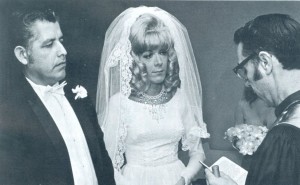 |
| The Wedding Antonio Molina and Billie Ert |
The wedding garnered press attention (reporting it as a wedding between two men) and when Molina and Ert attempted to return their marriage license so the marriage could be registered the county clerk refused.
Attorney General Martin quickly issued an opinion supporting the actions of the clerk in refusing to register the marriage and suggesting Ert could be prosecuted (there’s no evidence that she ever was).
The tizzy over Molina and Ert’s wedding coincided with a massive shift in the state legislature. In response to the Sharpstown scandal (a real estate scheme gone bad that involved many members of the legislature) the way Texas elected some of its representatives changed. Other incumbent lawmakers lost their re-election bids or didn’t run for re-election as a result of the scandal. The result was the largest class of new lawmakers in Texas history and a chaotic legislative session that began just three months after the Molia/Ert nuptials.
In that chaos House Bill 103, a revision to the Family Code, quietly became the newest marriage battleground. While the bill was in committee someone, whose identity has been lost to history, attached an amendment inserting language into the Family Code that marriage was between a “man and a woman.”
The amendment was adopted by the House by a voice vote, so there is no record of any opposition. The House Journal reflects no debate on the measure.
So – very quietly, and with no fanfare – the Texas legislature passed the first anti-marriage law in the history of the state. Contrast that with the lawmakers lining up in 1998, 2003 and 2005 (and 2015) to put their imperator on anti-marriage legislation. Was the idea simply too distasteful in 1973 to warrant public comment? Or was this an intentional effort to quietly pass legislation? There’s no way to know.
The law went into effect on Jan 1, 1974. So the next time someone tries to tell you that “marriage has always been between a man and a woman.” You can tell them “not in Texas law, not before 1974” and then tell them about Crawford Martin, Antonio Molina, Billie Ert and how Texans have been on the front lines of the marriage fight for decades.
Saturday, September 12, 2015
Despite EEOC Ruling Local Non-Discrimination Ordinances Still Needed in Texas
This post originally appeared on the Equality Texas Blog.
(Note: this post is about the EEOC ruling on sexual orientation discrimination in employment. It does not discuss employment discrimination based on gender identity or expression or discrimination in public accommodations or housing. None of which should be interpreted to mean that those kinds of discrimination aren’t important or deserving of attention, only that this is a narrow conversation about a specific administrative ruling)
![140px-US-EEOC-Seal.svg[1]](http://www.equalitytexas.org/wp-content/uploads/2015/08/140px-US-EEOC-Seal.svg1_.png) The July 16th announcement
by the EEOC that it considers sexual orientation discrimination in
employment to violate federal law is one of the most important, and most
confusing, victories in LGBT history. Immediately the questions began:
does this mean an employer can be sued for discriminating against LGBT
employees? Do we still need state and local non-discrimination
protections? Do we still need a federal employment non-discrimination
law?
The July 16th announcement
by the EEOC that it considers sexual orientation discrimination in
employment to violate federal law is one of the most important, and most
confusing, victories in LGBT history. Immediately the questions began:
does this mean an employer can be sued for discriminating against LGBT
employees? Do we still need state and local non-discrimination
protections? Do we still need a federal employment non-discrimination
law? What did the EEOC rule?
As you’ll recall from eighth-grade civics class, the government has three branches: the legislative which makes laws, the executive that enacts and enforces laws, and the judiciary that interprets laws. The EEOC is part of the federal executive branch. The EEOC cannot make laws, but, as part of its mission to enforce laws, it has to make decisions about how it thinks laws should be enforced.So how did the EEOC say they would interpret the law? The ruling says that the EEOC will interpret employment discrimination based on sexual orientation as a form of sex-based discrimination. The EEOC is saying that discrimination based on sexual orientation is based on the presumption of who someone “should” be romantically and/or sexually attracted to, based on their presumed “sex.” Since the discrimination is predicated on the sex of the person discriminated against – it’s sex discrimination. The ruling applies only to employment that falls under the EEOC’s purview. That includes: most federal employees; employees of most federal contractors; and, private employers with more than 15 employees. Anyone who experiences employment discrimination based on sexual orientation from an employer that doesn’t fall into those categories is out of luck. In the case of private employers with more than 15 employees, they will likely have to dedicate substantial personal resources to pursue their claim, but more on that later.
We tend to think of the executive branch as the most powerful branch of the federal government (the President is, after all, “the leader of the free world”), and the executive is certainly the most nimble of the three federal branches. By necessity it has a top-down decision making structure and can quickly respond to new situations in a way that the legislative, with its deliberative decision-making process, and the judiciary, with its endless review and appeals process, cannot – but that also means the executive rulings are the least permanent of the three branches. As has been often noted “in America, we get the opportunity to overthrow the government every four years.” The Commissioners of the EEOC are appointed by the president and affirmed by the US Senate. Any administrative interpretation in law is subject to the whims of future administrations.
The EEOC ruling did not take place in a vacuum. At least ten federal courts have ruled, in one form or another, that sexual orientation discrimination constitutes a form of sex discrimination. It is those rulings that the EEOC turned to in trying to decide how to interpret the law. The ruling is a guess: “if we made this argument in a federal court, would the judge agree?” Based on the precedents that already exist the EEOC is guessing that yes, the court would agree – but whether or not they are correct has yet to be tested.
Once EEOC interpretations wind up in court, a judge may tell the EEOC that they are wrong. It is also possible that Congress might come along later and pass a new law that supersedes the EEOC’s interpretation. So whether it is by the actions of a later administration, the review of the judiciary, or the law making power of the legislative, this ruling by the EEOC lacks permanence.
What about State Government?
![Texas-Workforce-Commission[1]](http://www.equalitytexas.org/wp-content/uploads/2015/08/Texas-Workforce-Commission1.png)
State employees who experience employment discrimination may be able to sue the state for employment discrimination, but when then-Attorney General Abbott was sued for sexual orientation discrimination in employment in 2009 he argued in court that no such protections existed. The case was disposed of on other grounds, so the court never addressed Abbott’s argument. It is likely that state employees do have such protections, but it has never been tested in state court. Only the Texas Commission on Environmental Quality, of all state agencies, has a policy prohibiting employment discrimination based on sexual orientation. The AG’s office used to have a policy prohibiting employment discrimination based on sexual orientation, instituted by AG Morales and continued by AG Cornyn, but Abbott revoked the policy.
Employment nondiscrimination bills have been filed in the Texas legislature for over a decade, advancing furthest in 2013 when both the Senate and House version received committee hearings, but no bill has ever advanced past the hearing stage.
How do Municipal Non-Discrimination Ordinances differ from the EEOC process?
Finally, we come to local governments. Texas law does not allow counties to pass employment protections countywide, only for their employees, and a couple of counties have done so. Cities, on the other hand, at least the larger ones, can (the rules are different for cities with populations under 5,000). Dallas, Fort Worth, Austin, Houston, and Plano have done so (although Houston’s is not currently being enforced, and Plano’s is written poorly).Well, “so what,” you say. Two out of three branches of the federal government believe that most employment discrimination based on sexual orientation is prohibited under the law, and that is not bad. Why bother continuing to push for municipal protections?
Because the way that municipalities pursue employment protections is different from the way the EEOC does.
Broadly speaking, you can divide the law into two categories (and before the legal pedants comment, yes I know – it is more complicated than that): civil and criminal. Civil law is about how one person’s actions affect another person. Criminal law is about how one person’s actions affect the state (as represented by the government). When your actions harm another person that person can, under certain circumstances, take you to court to force you to either fix the problem or to pay them money to make up for causing the problem. When that happens, it is the person who is taking you to court who handles pays for all the lawyers and court fees associated with the case. When your actions harm the state, the government handles the costs associated with the case.
Federal employment protections are civil law. In Texas, municipal employment protections are criminal law.
So, if you experience employment discrimination based on a federally protected characteristic (Age, Disability, Genetic Information, National Origin, Pregnancy, Race, Color, Religion or Sex (which is inclusive of both Sexual Orientation and Gender Expression under EEOC rules)) you can file a complaint with the EEOC. In some cases, discrimination based on active duty military deployment is also covered, but the EEOC does not handle it. They will investigate that complaint unless the complaint is against the government as an employer or a government contractor. However, if the EEOC finds that your complaint has merit, and they aren’t able to get your employer to agree to a settlement, in most cases they will give you a letter giving you their blessing to sue your employer. It will be up to you to find a lawyer to take the case and figure out how to pay for them and the court costs associated. There are some limited situations where the EEOC might represent you in a private employment discrimination case. There are some wonderful legal aid organizations out there that are stretched thin trying to help people pursue these cases, but for most people facing employment discrimination they will be stuck footing the bill for litigation that can take years with the risk of never resulting in a positive court ruling.
How many people do you know with those kinds of resources? As the corporate world has increasingly adopted internal non-discrimination policies with internal processes for addressing discrimination, the people most lacking in a process to address the discrimination they face are people who don’t take home the kind of salaries needed to literally make a federal case out of discrimination.
“
Protections that aren’t
|
Protections that aren’t accessible to the most vulnerable among us are not really protections at all and municipal non-discrimination protections provide a level of accessibility that federal protections simply do not.
Now, there’s a downside to pursuing complaints through criminal law rather than civil law. In that, since it is the state and not the individual who is pursuing the case, the state and not the individual receives the fine. While municipal protections are more accessible, they are less likely to result in a case with a ruling to compensate a discriminated individual in any way. This is why we also need federal and state protections.
Oh yeah! State protections! How do those work?
Texas law covers employment discrimination based on Age Disability, National Origin, Race, Color, Religion, Sex (not including sexual orientation or gender expression or identity). Military Status is covered only for state military services and whether a person left a workplace in compliance with an evacuation order (like a hurricane). Complaints made to the Texas Workforce Commission’s (TWC) Civil Rights Division are also reported to the EEOC. The TWC will first seek mediation just like the EEOC and municipal agencies. Then, if that fails, they further investigate the case and refer it to a panel. If the panel agrees discrimination likely took place, just like the EEOC, they will give you their blessing to sue – but they usually won’t help you do it.The EEOC ruling means that probably, under the right circumstances, an employer can be sued for employment discrimination based on sexual orientation. This is in no way means that local, state and federal laws are no longer needed.
The EEOC’s ruling on sexual orientation employment discrimination lacks sufficient permanence, and enough accessibility to be the final word on non-discrimination protections. We must continue to pursue protections at the state and municipal level and to defend the municipal protections that already exist.
Thursday, August 6, 2015
50th anniversary of the Voting Rights Act
Today marks the 50th anniversary of the #VotingRightsAct. Theresa Burroughs came of voting age during the Jim Crow Era, the board of registrars at Alabama's Hale County Courthouse prevented African Americans from registering to vote. Determined to practice her civil right Theresa remembers venturing to the courthouse on the first and third Monday of each month. Today, watch StoryCorps' astounding #AnimatedShort A MORE PERFECT UNION.
Subscribe to:
Posts (Atom)